
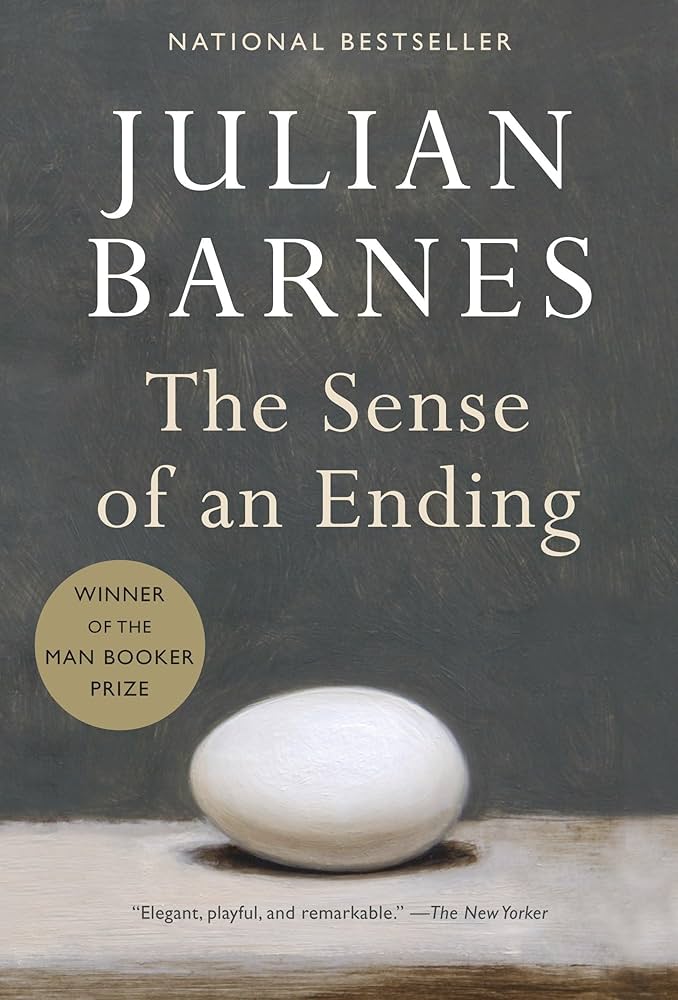
The Sense of an Ending by Julian Barnes is an intriguing novel that I ultimately found disappointing.
This is a story and exploration of memory, how we remember things, and how we view ourselves. Tony, the narrator, shares parts of his life, particularly revolving around a friend made in youth, Adrian, his first relationship with a woman named Veronica, and how they got together after Tony’s relationship with her fell apart. However, somehow, Adrian and Veronica’s relationship goes even worse, resulting in Adrian’s suicide. Now that’s some hometown lore if I ever heard it…
Tony and his friends are insanely annoying. Like the gang from A Clockwork Orange, these boys assault the reader’s senses with mind-numbing pretentiousness rather than random people in their homes. This made the first half a bit of a slog to get through. I guess England is a jockless nation because I have never heard of a group of boys who needed to be bullied more. Although, I think their insufferability is a piece of the larger puzzle.
The puzzle here, when jumping many years into the future (Tony is old and still annoying), is why Veronica’s weird mommy has left him a brick of cash and Adrian’s diary in her will. What follows is Tony using his superpower of being insufferable to convince Veronica to hand over the diary, which has fallen into her hands.
Tony is a narcissist and struggles to come to terms with the fact that he is not the cool, self-aware nice guy that he imagines himself to be. I especially like it when, instead of the diary, Veronica hands him the note that he wrote her and Adrian when discovering that they got together. It was so cruel, and I audibly shouted “DAMN!” at most of the digs aimed at them. I’ll concede one point to the British, Americans cannot even touch them when it comes to passive-aggressiveness. We may have taken the 13 Colonies from them, but I’m sure they wrote some very cutting pamphlets about it.
Anywho, the dissonance between what Tony remembers saying and doing is very different from his actual actions. His lack of understanding, retrospectively painting himself as a victim, and entitlement come crashing down when reality slaps him in the face. Still, he struggles to understand and come to terms with the fact that he’s lived his whole life in this sufferable way.
However, that reality is where the book becomes a contrived soap opera. Whaaaat?! Turns out Adrian actually had an affair with Veronica’s mom! Woaahhhhh!! Turns out he isn’t the golden child that Tony remembers, eh, chap? And they had a child together, and that’s why he killed himself! Blimey! For real, what British mystery show was on in the background when Barnes wrote that conclusion, which was barely alluded to in the book. The only hint is that Adrian (very smart, insightful) writes a formula in his journal that’s like, “Adrian + V’s Mommy = Baby?! I must recheck my maths!” It was so insanely corny and ham-fisted that it soured my experience with the book.
Still, I liked the dreamy insecurity of memory that Tony suffers. And I like the sad old-manness of the second half of the book. It made me feel strange about my own past, whether I remember difficult things in a way that paints me in a flattering light, and whether I gave people who I thought wronged me enough grace. The answer to those questions is: of course, I was right and justified in every action I’ve ever taken, and my mind is an iron fortress that remembers all things. Thank you.
3/5