
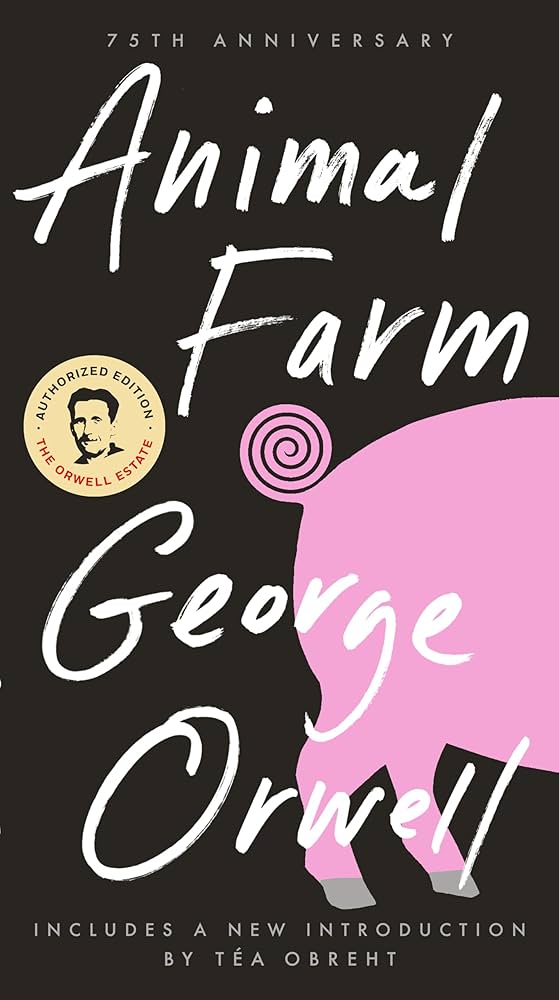
And guess what else, I did the damn Orwell double feature. As my many admiring fans may have noticed, I just read Orwell’s Homage to Catalonia, and the library had no waitlist for Animal Farm, so I said LET’S RUN IT BACK!!!
George Orwell’s Animal Farm is an interesting exploration/parable that was almost definitely informed by his experiences in the Spanish Civil War after the Soviet-backed communists betrayed the movement to fight fascism and violate their stated principles. Published just 7 years after Homage to Catalonia, I read that he had trouble publishing this one because the British government didn’t want to criticize their ally, Joseph Stalin of the Soviet Union.
Kind of crazy to read a critique like this at an insane time like this while Europe was embroiled in absolute chaos. Especially because this book is like a bizarre fairy tale that features walking and talking animals that overthrow their farm to establish a form of communism known as “animalism,” which backfires once the “pigs” twist the movement until it’s basically another form of capitalist subjugation. And yes, before you lunatics come for me, I believe this is NOT a critique of communism. It is a critique of the authoritarian version of communism that was ushered in by Stalin after the revolution, some 20 years prior to Animal Farm’s writing.
Really, most of the animals on Animal Farm cannot read and are led through this revolution almost blindly, and life is good for a while when the revolutionary tenets are followed. However, the pigs begin to backstab one another and rile the other animals up into a paranoid frenzy, which ultimately leads to more exploitation. Imagine that, the guy who fought for socialism in Spain and was betrayed by the propaganda and disingenuous actors from Soviet Russia wrote about it happening but to animals.
If I can be honest, I didn’t really care too much for the parable/heavy-handed metaphor of animals, which are at the forefront of this novel. It feels very juvenile, which, on one hand, makes a complicated issue more digestible (why they make children read this one in schools), and on another makes some of the creative choices eye-rolling and overly simplistic. Also, by making the characters animals, it imbues each species with certain attributes that can’t really be replicated by the others. The pigs are manipulators or leaders, the horses are workers, the sheep are mindless followers, of course. I think it makes some of the characters and their real-life analogs stereotypical and one-dimensional. But I guess that’s the point for a short book like this.
I think something bugs me about talking animals in principle. They can’t do that!! That’s a thing only people and parrots can do! As somebody with an (unfortunate) background in improv comedy, the lowest form of a scene is when people debase themselves by playing talking animals. Do not ever come out on stage in some black box theater mooing like a cow. I will destroy you.
3/5