
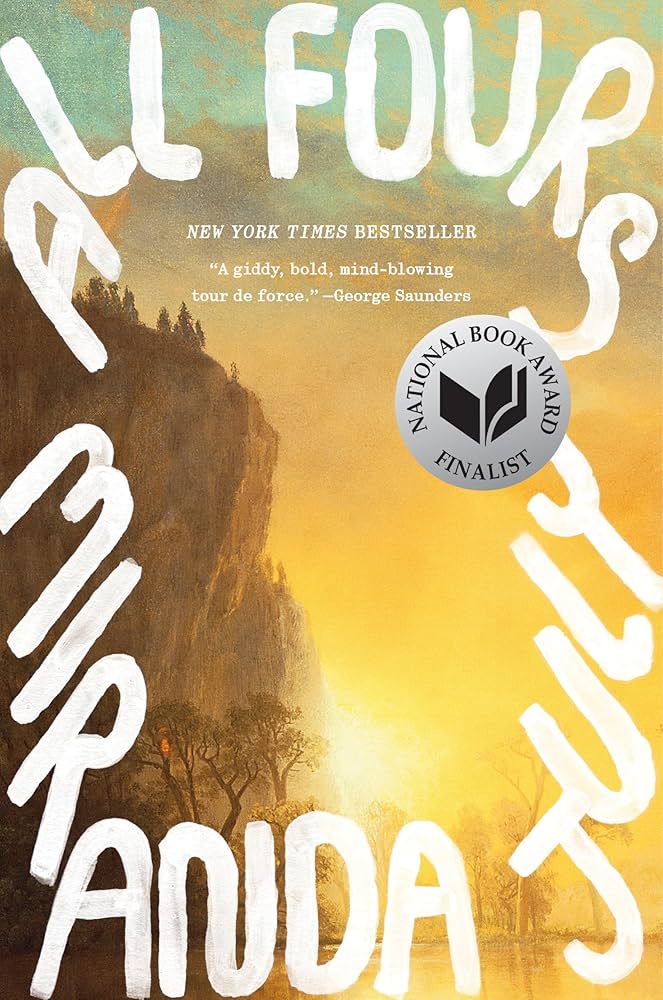
All Fours by Miranda July was a complicated and challenging book to dive into. The nameless protagonist undergoes a physical and emotional transformation over the course of the book, from a more conventional domestic lifestyle to an open, liberated lifestyle focused on personal relationships and sexual freedom. This transformation, intimate and existential, happens in tandem with (or because of) the onset of menopause. July described her book as a coming-of-age story during the other point in a woman’s life when hormonal changes can cause massive self-reflection and upheaval. In this sense, the novel crucially brings attention to this often-overlooked aspect in the lives of women. Through this lens, July thoughtfully and entertainingly prods commonly held notions of motherhood, sexuality, marriage, family, feminism, and friendships/relationships. Her prose is often easy to read, funny, insightful, and gross in an awesome way, and I flew through this book quickly because I couldn’t wait to find out what happened next!
I do have some issues with this book, though. The narrator, on her essential journey of self-discovery, is quite frantic, reckless, self-indulgent, a tad narcissist, and totally obsessive. This is a good thing. Exploring complicated subjects through complicated characters isn’t new but can continue to add richness to stories. However, the book itself doesn’t really challenge any of the protagonist’s decisions, explicitly or implicitly. Her affairs, crucial for her growth, are imbued with a sense of danger that doesn’t come to fruition. The intrusive thoughts won out. She talks about how she explodes her old life in favor of this new, more liberated one, free of motherly and domestic responsibilities, dedicated to exploring herself and others (“driving” rather than “parking”), but this explosion comes with no real cost. Harris, her husband, treats her coldly for about a week; her best friend, Jordi, supports her unconditionally; her child is just there, providing psychic guidance and plot points when necessary; and the other side characters, whose lives she should have a tremendous, possibly damaging impact on, undergo no change. In Harris’s case, the discovery of his wife’s infidelity, an important tension throughout 3/4 of the book, ends with an “Okay, let’s open up our marriage, then.” What? That’s it? Even for characters like Claire, an interesting foil whose husband-to-be has cheated on her, goes on blissfully unaware, unphased by the chaotic storm the protagonist presents (maybe because she was paid off?). In reality, the only real challenges the protagonist faces are internal.
Clearly, this book is semi-autobiographical, and I think this complicates things in a way I wasn’t quite expecting. While I am usually a big fan of this sort of writing wholesale, I thought the author’s closeness to the main character stops her from examining her choices and her impact on other people beyond just what they bring to her. The protagonist’s selfishness, which might be critiqued in a meta, nuanced, or satirical way in another book, is, to my understanding, seemingly endorsed by the author through her storytelling. Should stories be written about selfish characters with relatively easy lives who decided to make bad, irresponsible decisions that ultimately lead to a place of a happiness and more fulfilling relationships, including with oneself? Absolutely, yes. Should those systems and institutions (motherhood, marriage, etc.) be challenged in the ways presented in the book? Sure, and I like that they are. However, it’s difficult for me to reckon with her transformation when the world around her is mostly flat, on-rails, and convenient at every turn in the face of her erratic decisions. I suppose if this is how this story unfolded for the author herself, then who am I to call it unrealistic or disingenuous?
With that said, the struggle she has internally with her body is where the book shines. The crisis over the future/supposed loss of her sexuality as she knows it becomes the driving force throughout the second half of the book, especially considering that if she doesn’t figure it out, she may suffer the same fate as her aunt and grandmother. Her change into somebody more comfortable with the uncomfortable and aging itself is enlightening, breaking her familial cycle. Particularly, her conversation with other women on the subject of menopause was interesting. It’s because of this aspect that I think this is a pretty important but flawed novel. And it should be said: YES, I enjoyed the weirdo sex scenes. YES, I enjoyed when she acted like a total unhinged freak. YES, the book club I’m participating in for this book could get awkward.
I think this novel wraps up too neatly, but I overall enjoyed reading it. I struggled with the arch of the story and some of the characterizations, but the themes and prose were great. I kind of feel like there’s something I am missing out on here. This was kind of like the most annoying person you know winning the lottery. Like, I’m so happy for them, and I’m sure they’re going to spend it on something good. Oh, they’re remodeling a hotel room? Huh, that’s neat, I guess.
3/5