
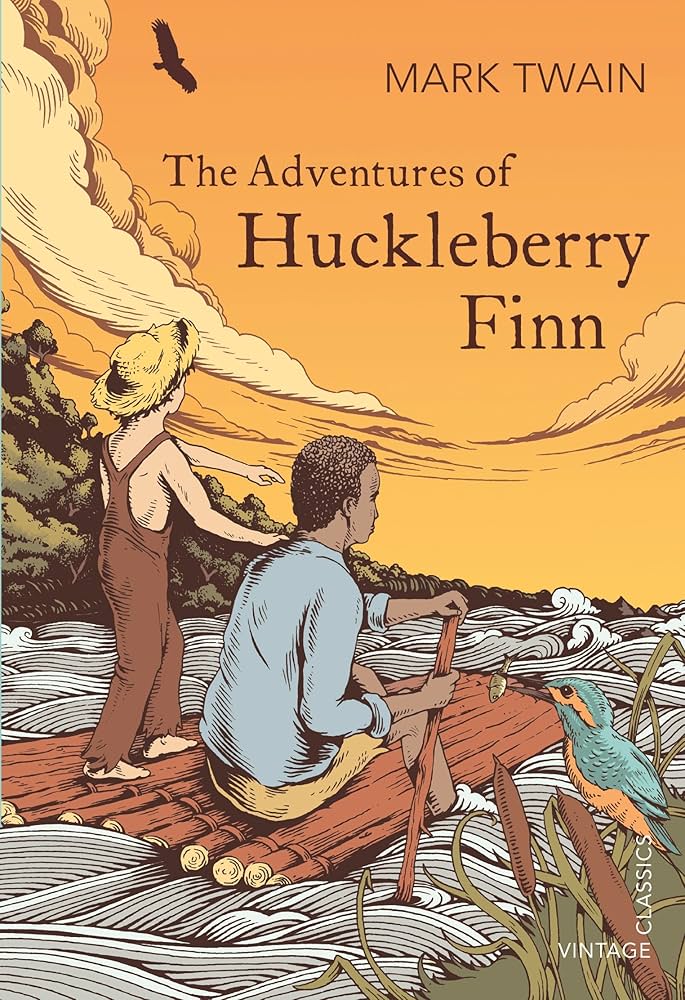
Yup, I have once again reread The Adventures of Huckleberry Finn for the fourth or fifth time. Mark Twain’s most famous novel is a biting satire of southern society, a coming of age story, a tale of empathy resisting cultural norms, and a foundational “American” novel. Huck Finn, our narrator and protagonist, is a young teenager living on fringes of White society. The sequel/spinoff to The Adventures of Tom Sawyer, the book follows Huck has he escapes his abusive father and the “sivilized” culture of slavery and hypocrisy. He joins up with Jim, a Black man escaping slavery, and they travel down the Mississippi River, getting into “adventures” (or conflicts) with various characters (feuding families, slave hunters, con men, etc.), to escape the backwards social order they’ve experienced. Just like the text itself, they must venture deeper into the racist slave society in order to escape it.
However, Huck Finn struggles with his decision to embrace or disregard the society. To Huck, the enforcement of slavery is morally right, civilized, and required by law. His resolve to be “immoral” and save Jim, damning himself to hell, is one of the most poignant moments in all of American literature. The racial elements to this book are extremely complex, and one has to really consider the time it was made and the cultural context Mark Twain lived in and the audience he wrote for. This is a book that exhibits abhorrent racism, but it is one of the greatest anti-racism books to ever be written by a White man. As a satire on southern society, it must cloak itself in its language and attitudes to break through the commonly held biases at the time. Through its language, it (tragically) grounds it in the racist reality in which the characters lived and makes Huck Finn’s transformation incredible but also incomplete.
The unfortunate truth about the ending of this book is that it sucks. After Huck decides to cast off the society that labels his friend property, he sharply regresses once my mortal enemy Tom Sawyer is reintroduced to the story. Through some absurd plot convenience, dumbass Tom Sawyer has reared his stupid little head at a random home miles and miles away from their hometown. Through more plot conveniences, the family holding Jim is that of Tom Sawyer. And Huck is confused as Tom Sawyer, so he and Tom have plenty of time to plot the most frustrating escape plan to win Jim’s freedom, which involved tremendous unnecessary suffering on the part of Jim. The book comes to a screeching halt as Tom fights Huck on every single point of the escape. It lasts FOREVER! And it makes me so damn mad that after all that growth, Huck and Jim will both follow the whims of some child who (hopefully canonically) will die in the Civil War. I can say that and not get canceled because Tom Sawyer is not real.
Despite my complaints, I have to believe that this frustrating ending is the point. Tom Sawyer, whose fantasy logic is symbolic of the cruel southern logic behind enslavement, embodies the privileged White supremacy that controls the bottom rungs of society, i.e., Huck and Jim. Once again operating under this society, they have no choice but to obey the likes of Tom Sawyer, my mortal enemy. In that sense, it might be an honest (yet disturbing) ending that still gives hope to the further growth for Huck Finn and freedom for Jim.
I know I talked a lot of the ending and plot, but the writing itself is amazing and challenging. Crazy how Mark Twain opened the floodgates for American writing to be written in a cool, chill way (i.e., not in geeky highfalutin language). This is an essential book for the story, writing, humor, and tragedy of it all. Now, I’m going to Tom Sawyer’s house to teach him a lesson, and if you drive by later and see me painting his fence, I want you to shoot me in the head.