
 And guess what else, I did the damn Orwell double feature. As my many admiring fans may have noticed, I just read Orwell’s Homage to Catalonia, and the library had no waitlist for Animal Farm, so I said LET’S RUN IT BACK!!!
George Orwell’s Animal Farm is an interesting exploration/parable that was almost definitely informed by his experiences in the Spanish Civil War after the Soviet-backed communists betrayed the movement to fight fascism and violate their stated principles. Published just 7 years after Homage to Catalonia, I read that he had trouble publishing this one because the British government didn’t want to criticize their ally, Joseph Stalin of the Soviet Union.
Kind of crazy to read a critique like this at an insane time like this while Europe was embroiled in absolute chaos. Especially because this book is like a bizarre fairy tale that features walking and talking animals that overthrow their farm to establish a form of communism known as “animalism,” which backfires once the “pigs” twist the movement until it’s basically another form of capitalist subjugation. And yes, before you lunatics come for me, I believe this is NOT a critique of communism. It is a critique of the authoritarian version of communism that was ushered in by Stalin after the revolution, some 20 years prior to Animal Farm’s writing.
Really, most of the animals on Animal Farm cannot read and are led through this revolution almost blindly, and life is good for a while when the revolutionary tenets are followed. However, the pigs begin to backstab one another and rile the other animals up into a paranoid frenzy, which ultimately leads to more exploitation. Imagine that, the guy who fought for socialism in Spain and was betrayed by the propaganda and disingenuous actors from Soviet Russia wrote about it happening but to animals.
If I can be honest, I didn’t really care too much for the parable/heavy-handed metaphor of animals, which are at the forefront of this novel. It feels very juvenile, which, on one hand, makes a complicated issue more digestible (why they make children read this one in schools), and on another makes some of the creative choices eye-rolling and overly simplistic. Also, by making the characters animals, it imbues each species with certain attributes that can’t really be replicated by the others. The pigs are manipulators or leaders, the horses are workers, the sheep are mindless followers, of course. I think it makes some of the characters and their real-life analogs stereotypical and one-dimensional. But I guess that’s the point for a short book like this.
I think something bugs me about talking animals in principle. They can’t do that!! That’s a thing only people and parrots can do! As somebody with an (unfortunate) background in improv comedy, the lowest form of a scene is when people debase themselves by playing talking animals. Do not ever come out on stage in some black box theater mooing like a cow. I will destroy you.
 Homage to Catalonia is George Orwell’s account of the Spanish Civil War. Originally signing up to cover the war as a reporter, Orwell almost immediately enlisted to fight against fascist forces in Spain, and this book recounts his experiences about six months after he fled the country.
You know, I didn’t realize that Orwell was a prolific nonfiction writer until I read The Art of the Memoir by Mary Karr. When you hear the name “Orwell,” you immediately think of 1984 (which is also the year Nightmare on Elm Street came out), just as when you hear the name “Hatfield” you immediately think “cool guy.” It’s weird to think of him outside of his cultural image built around his seminal work, which in recent memory has been used by the right-wing to lambast communism and leftist ideals.
I haven’t read 1984, so I can’t really speak to that myself (though I am skeptical about those claims), but I can say that Orwell wasn’t a right-wing guy, and he fought alongside socialists in Spain and spoke highly of anarchists. While he wasn’t opposed to communism, it seems, he and the other parties fighting against Franco’s fascist forces were betrayed by Soviet-backed communist forces to form an alliance with the liberal government; many militia members, including Orwell’s comrades (and nearly himself), were thrown into jail or killed. This is according to his account, which is prefaced as solely his own, and warns against the frantic lies and propaganda of most parties writing about the war from abroad. I wonder where he got the idea to write about propaganda in his fiction…
Because this is just his on-the-ground account, written shortly after he left Spain but before the war concluded, this is not a comprehensive history of the events that transpired, and when he tries to explain the politics and conflicts happening, it’s quite confusing (mostly because everybody back then was obsessed with acronyms). This is definitely not the account to read for a thorough history of the conflict, but I’m sure it’s an excellent supplement.
Where this account shines is in its details and descriptions of the events that happened to Orwell personally. Did you know he was shot through the neck and lived? What the hell. Maybe if I start behaving like a snarky British man, I too could take an otherwise fatal bullet when a similar civil war erupts in America. His witty, insightful accounts are ripe with clever details about the men he fought alongside, the sordid conditions, and the rampant paranoia once left-leaning forces collapse.
Overall, his was an excellent memoir about an idealistic man who went to the forefront of the fight against fascism and became greatly disillusioned about the fight itself, how it was used exploitatively by malicious opportunists, and how he escaped with a deep resentment of the world and profound respect for the Spaniards who fought but failed to prevent their country’s slide into brutal authoritarianism.
Not to be “that guy,” but isn’t it crazy that popular authors used to do crazy stuff like this? When is Sally Rooney going to go fight North Korean soldiers outside of Kyiv? Or firebomb the village that Melania Trump crawled out of?
 The Housemaid by Freida McFadden is a book that was written.
This is a book I didn’t think I would like going into it, and it turns out I was right. Everybody else also thought I wouldn’t like it, and it should have come with a label that read, “Ryan, do not read.” Fun fact: Turns out, Freida McFadden is actually a brain surgeon by day and decided to extend her craft by giving a mass lobotomy to society with her writing.
I think, on the whole, this book is sloppy fun for people. I am glad people get enjoyment out of this, perhaps in a similar way to how I enjoy absolute pulpy trash I find in the recesses of Amazon Prime Video. The story is frustrating and drags on even though it’s technically easy to read due the simple prose, which is full of clichés and the same mind-numbing descriptors used over and over. The mystery isn’t really a mystery, more of “turns out all the characters were lying the whole time” kind of book. No tells, no hints, no nothing.
The characters are flat except for maybe the titular housemaid who has her signature Spunk©. Although, what makes her character interesting in the first chapter mostly dissipates by the 1/4th mark. Eventually, this book devolves into a revenge fantasy that involves a torture chamber??? The main character tortures and kills a guy?? A very bad guy, but like what?? It ends happily, of course, and the housemaid becomes a vigilante who will go on to save housewives in danger. Yippie! It’s kind of fun how stupid it is.
At the very least, it gave me a newfound appreciation for more competent mystery novels, even ones I have previously disparaged. See guys, I am growing! You may be asking yourself, “Ryan, why did you read a book that you knew you would hate?” The answer, dear reader, is friendship. When my friends ask me to jump, I say, “How high?” When my friends ask me to read a book with them, I say, “How long? Oh, 300ish pages? That’s not too bad.”
I am sure this is a better movie than a book, which was also apparently admitted by the author. Maybe, in 20 years, when I find it in the bowels of Amazon Prime Video (who also by this point will own my house, television, and parts of my brain), I will like this story.
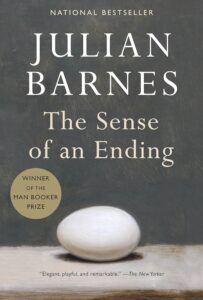 The Sense of an Ending by Julian Barnes is an intriguing novel that I ultimately found disappointing.
This is a story and exploration of memory, how we remember things, and how we view ourselves. Tony, the narrator, shares parts of his life, particularly revolving around a friend made in youth, Adrian, his first relationship with a woman named Veronica, and how they got together after Tony’s relationship with her fell apart. However, somehow, Adrian and Veronica’s relationship goes even worse, resulting in Adrian’s suicide. Now that’s some hometown lore if I ever heard it…
Tony and his friends are insanely annoying. Like the gang from A Clockwork Orange, these boys assault the reader’s senses with mind-numbing pretentiousness rather than random people in their homes. This made the first half a bit of a slog to get through. I guess England is a jockless nation because I have never heard of a group of boys who needed to be bullied more. Although, I think their insufferability is a piece of the larger puzzle.
The puzzle here, when jumping many years into the future (Tony is old and still annoying), is why Veronica’s weird mommy has left him a brick of cash and Adrian’s diary in her will. What follows is Tony using his superpower of being insufferable to convince Veronica to hand over the diary, which has fallen into her hands.
Tony is a narcissist and struggles to come to terms with the fact that he is not the cool, self-aware nice guy that he imagines himself to be. I especially like it when, instead of the diary, Veronica hands him the note that he wrote her and Adrian when discovering that they got together. It was so cruel, and I audibly shouted “DAMN!” at most of the digs aimed at them. I’ll concede one point to the British, Americans cannot even touch them when it comes to passive-aggressiveness. We may have taken the 13 Colonies from them, but I’m sure they wrote some very cutting pamphlets about it.
Anywho, the dissonance between what Tony remembers saying and doing is very different from his actual actions. His lack of understanding, retrospectively painting himself as a victim, and entitlement come crashing down when reality slaps him in the face. Still, he struggles to understand and come to terms with the fact that he’s lived his whole life in this sufferable way.
However, that reality is where the book becomes a contrived soap opera. Whaaaat?! Turns out Adrian actually had an affair with Veronica’s mom! Woaahhhhh!! Turns out he isn’t the golden child that Tony remembers, eh, chap? And they had a child together, and that’s why he killed himself! Blimey! For real, what British mystery show was on in the background when Barnes wrote that conclusion, which was barely alluded to in the book. The only hint is that Adrian (very smart, insightful) writes a formula in his journal that’s like, “Adrian + V’s Mommy = Baby?! I must recheck my maths!” It was so insanely corny and ham-fisted that it soured my experience with the book.
Still, I liked the dreamy insecurity of memory that Tony suffers. And I like the sad old-manness of the second half of the book. It made me feel strange about my own past, whether I remember difficult things in a way that paints me in a flattering light, and whether I gave people who I thought wronged me enough grace. The answer to those questions is: of course, I was right and justified in every action I’ve ever taken, and my mind is an iron fortress that remembers all things. Thank you.
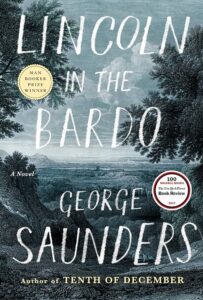 When I started Lincoln in the Bardo by George Saunders, I picked it up, read the first chapter, flipped through the pages, noticing how many chapters were less than a page, and thought, “Oh nice, this will be a breeze.”
I was so insanely wrong that there should be a prison sentence attached to my miscalculation. This book was challenging, and I didn’t understand what was going on for the first 100 pages and until I read a summary on Wikipedia. Reading it often felt like a mind-numbing chore, but it did impart a very powerful feeling of grief and love. Once I understood what was going on, I appreciated it much more; and the writing itself was really impressive and creative.
This is one of those “feelings” books. Its style, setting, and dreamy atmosphere are meant to bestow feelings, including confusion. It’s one of those books that begs to be reread (see: 1 billion characters with their own unique stories and use of language). To the uninitiated, I would do some research or read a summary before tackling this book (which I typically do for something like Shakespeare’s plays) to get a more satisfying read the first time around.
I typically don’t like historical fiction, and I love Lincoln, so I was worried that I would just hate an attempt at writing about an imagined Lincoln. However, the premise and characters are mostly otherworldly, and Saunders approaches the best U.S. president with grace and respect. This book takes big swings in style and form, and this book earns a lot of Ryan points for that alone. Some of the swings I didn’t care for, especially how corny some of the sequences at the end were (see: exploding ghosts, mass possession, etc.), but the craziness is better than middling wrap-up that a lesser author might have gone with.
One of the best modern short story writers wrote a novel that is basically 100 short stories with a larger overarching narrative. His weird short stories lend themselves to rereading, and this is no different, but I will need some time before I dive back into this difficult book. When I am behind bars, I will have plenty of time to reread and truly appreciate this book.
There was enough that I liked in Erik Larson’s The Devil in the Wh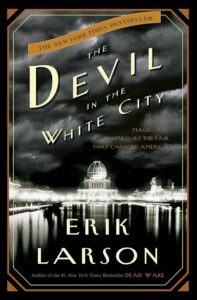 ite City. The premise, about the building the Chicago’s 1893 World Fair and a serial killer who also happened to be there, is a bit of a hodgepodge, which lends itself to the chaotic result of the fair; however, it was disjointed and a bit of a slog.
I probably would have preferred a book about one or the other, or maybe I read this when I wasn’t quite in the mood to appreciate a book that has parallel narratives linked by the ruthless dedication to building/destroying. If you’d like to know about the kind of city Chicago was (and in some ways still is), I’d definitely recommend this. The author takes some creative liberties, in the classic imaginings that still count as nonfiction, about how the killings took place. What this book does for the genre is vital to the craft.
As a portrait of a certain place at a certain point in time, reflecting the themes of the country on the whole, this book definitely succeeds. Definitely going to put off my reading of “In Cold Blood” by Truman Capote after this, though; I don’t know if the crime / mystery stuff is my jam. My jam is raspberry.
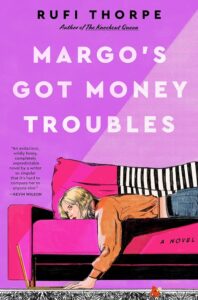 Margo’s Got Money Troubles by Rufi Thorpe is a book I thought I would enjoy… but, guess what, I did not. Is something wrong with me? I have read so many popular “it” books over the last year, the kinds of books you might find on the featured table at a Barnes & Noble or at the Strand, the kinds that are nominated for book awards or featured on Goodreads, and I have been totally disappointed by almost all of them. Am I the problem? Too harsh a critic? What the hell are all of you smoking?
Reading this book was like watching whatever new quirky sitcom is featured on NBC’s Thursday night lineup. The revolving cast of characters felt like characters on a television show, each with weird “things” that make them “interesting,” when most of them were flat or grating. Imagine my surprise when I discovered that this book got picked up to be a show for Apple TV before it was even published! This book is a psych op. It’s like the author asked ChatGPT, “Can you please make me a book that combines all of the hottest/most relevant cultural topics into a quirky yet heartwarming story about a dysfunctional family?” and this is what was produced. And then “Can you turn that book into a script to pitch to the streaming service that my phone also is?”
It’s relatively readable, but it’s totally aimless for the most part. It hints at some interesting themes it barely explores. It plays with form just enough to say that it technically did it. It takes pages to describe the intricacies of how to play Fortnite, but I KNOW how to PLAY Fortnite, I play EVERYDAY!!!!! I think more books about sex workers should be written and popularized, but this felt like a YA version of that. This is Millenial nerd quirky lit at its finest, but for me that’s a bad thing, and I wish whoever enjoyed this book an excellent day.
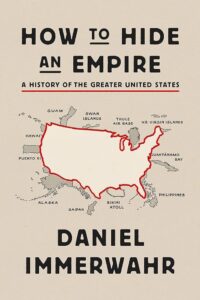 How to Hide an Empire by Daniel Immerwahr was a pretty good deep dive into the legacy of the United States as an imperial power (in the first half). In school, I, like others, never learned a thing about the U.S. colonies, such as the Philippines, Puerto Rico, or its many islands. Even Native American history was a blind spot. It dispels and dissects the legacies of American giants, such as Teddy Roosevelt, who was a war mongerer and loooooooved to provoke other nations into war so taht he could take their land. This book is relatively easy to read and a good entry point for those looking to learn about some of the darker elements about U.S. imperialism.
However, the second half of this book is all over the place (kind of like American empire, eh?). It devolves into little episodes of how American culture impacted other countries, which then return to the U.S. in other forms, such as Japanese products, British rock and roll, amongst others, which feel trivial after the first half and the little reflected upon reality of the U.S. domination across the globe. Little mention of the various coups orchestrated by the government, for example. The second half of this book is more slighting intriguing episodes of how the U.S. led the charge on, of all things, the shape of stop signs. Hey buddy, the Shah is dead, and we can talk about him.
Read the People’s History of the United States by Howard Zinn instead.
 Patrick Radden Keefe’s Say Nothing is a dramatic journalist retelling of the conflict in Northern Ireland during the Troubles beginning in the late 1960s. DAMN! That stuff is all really crazy. Keefe is a really fantastic writer: he brings in so many characters over the course of many decades, weaves them in and out of the narrative, and gives them such rich characterization that it was hard to root against literal murders and terrorists…
I have read that this is a skewed, incomplete portrait of the history of Northern Ireland, particularly how it ignores the barbarism of unionist paramilitary groups; however, ignoring that, this seems to be a great jumping off point to those who want to learn about the armed struggle against the British in Ireland, colonialism, how people become radicalized, how a cultural deals with guerilla conflict, and how justice can mean a lot of different things to different people.
 Herman and Chomsky’s Manufacturing Consent is an important piece of political analysis of the American project. I agree with the overall breakdown of the arguments and evidence and the author’s conclusions, and surely this was a landmark work in the media analysis at the time it was written.
To me, reading this in 2025, I kind of already understood a lot of the arguments and analyses. It was very interesting to learn about how manufacturing consent through the media reached its height during the Cold War (though that “height” is debatable), during a time when basically everybody was on board with the existential fight against communism. Works like this are crucial to understanding how the media shapes our opinion of the world, bends reality, and works to sway public opinion.
Honestly, though, the process of reading it was a bit of a chore. I got more out of the very long updated introduction, which summarizes most of the main points for the post-Soviet world. Now that I am done reading this, I am going to go watch Coca Cola commercials on Youtube.
 My jaw is on the floor at how this has received such universal acclaim across every platform and major outlet in the country. This is one of the most annoying, frustrating, pretentious, amateurish books I have ever read. I could keep going with a long list of adjectives, but then I would be as overwrought as this book.
Martyr! is a book with a lot of ideas, most of which are explored with little or surface-level depth. The writing is stuffed with self-indulgent prose, similes, and metaphors, most of which are so mind-numbingly stupid that I can only assume the author’s editor was in a coma while this was being published. There are so many unnecessary details included in the writing that made me audibly shout “who cares!” so often that I now have a noise complaint filed against me. All of the characters sounded the same; even characters who are real people or well-defined preexisting characters use the same annoying pseudo-intellectual language as our protagonist and the narrator.
This was the most cliché, corny book I have read this year (and likely in the last few years). It’s like a draft from an ENGL Creative Writing 201 class came to life, escaped the halls of academia, and won the lottery to become one of the “it” books from the last year. I beg this author to return to writing poetry, the industry to stop awarding first-draft books that do the minimum to explore form, and the person who read the audiobook to return to performing in soap operas.
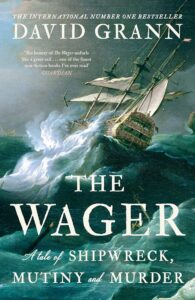 David Grann’s The Wager was a thrilling, shocking, and intriguing episode from an era of history I didn’t know too much about. The characters were so richly portrayed, and the drama of the shipwreck and survival was incredible.
I’m not usually one to really seek outwardly “thrilling” books, but this totally kicked ass. Grann makes it look easy to portray these events with such details, context, and interest, even though it would in practice be a mountain of work to go through all the historical documents and presenting it in a way that makes sense, especially considering the dueling narratives on the shipwreck.
Definitely going to be reading more from this author.
 I AM FINALLY FREE!!! To anybody has viewed my Goodreads profile since its humble beginnings, you may have noticed that I have been trying to read this brick for 2.5 years, picking it up and putting it down (or rather dropping it and creating a crater in the earth) when it got too dense, which is often.
This historical/anthropological behemoth by David Graeber and David Wengrow is an important modern reimagining/reexamination of our ancestors, the evolutions of social orders, and how we think about “civilization.” It presents some really intriguing arguments and evidence to expand our imagination of how ancient people organized their societies, uprooting most conventional wisdom of the march of “progress,” the foundings of democracy/equality, and the “inevitability” of things many of us do not question. It adds so much richness to various societies across the globe that existed before our capitalist world order. This book and its authors are also extremely combative to the narrow-mindedness of other historians and anthropologists, which is really awesome.
While this is easily a 4 or 5 star book, I just cannot possibly give it a great rating because it took me so long and was so difficult to get through. That’s a me problem. No book I have ever read has tested me more than this one. While there is so much to love and appreciate in this, it just did not grasp me consistently enough to keep me engaged. Still, this is a crucial work that should be read (or skimmed) by anybody interested in a meta narrative of the bend of society, specific and obscure voices from the ancient past, or various reflections on human nature and history. I also recommend this to anybody who enjoys suffering.
 The Message by Ta-Nehisi Coates is my first of his full-length work since I read Between the World and Me during undergrad, and while this book wasn’t as transformative as that one for me, this is a crucial perspective on the current moment. Between the attack on education, the post-2020 reaction of Black Lives Matter, Zionism, and the war on Palestine, Coates draws interesting connections between historical myths and how we tell stories (and more importantly, who we let tell those stories).
During my reading, many of the threads felt very loosely connected, but I thought they came together expertly. This is kind of a travel writing, where the places Coates goes are either haunted by the past and/or currently under massive systems of oppression. In a moment like the one we’re in, Coates bravely paints a portrait of life on the ground in small-town United States, the African coast, and occupied Palestine, interjecting his own reflections on his role as a writer and journalist. The book was a bit of a slow start for me, but by the end I couldn’t put it down. Coates is one of the best nonfiction writers we have!
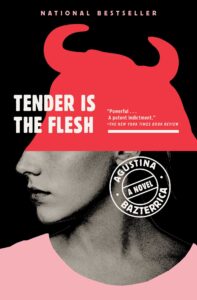 Tender Is the Flesh by Agustina Bazterrica paints a nasty portrait of a dystopian society of normalized and industrialized cannibalism. Well-written, disturbing, and vivid in its scenes of sterile horrors, this novel follows the life of a male employee of the human factory. He lost a child, is separated from his wife, and generally miserable, but doesn’t really understand why.
Bazterrica’s writing has a distance to it, which reflects the themes of disassociation from real-world horrors quite well. However, I think the book spends too much describing the banal processes behind the creation of human food products. Not that I don’t have the stomach for it; I am a tough guy and the master of my own mind. I much preferred the struggles, dreams, and growth (or lack-thereof) of the protagonist, who takes one of the women from his factory until his care.
This novel’s overarching metaphor of human consumption offers a lot in terms of commentary for feminism, animal rights, the banality of evil, and the extents of social conditioning. It made me want to read Orwell’s 1984, which, in real life, is the year that A Nightmare on Elm Street released in theaters, and Tender Is the Flesh a “nightmare” on every street. Kind of full circle, don’t you think?
 Love and respect to my opera heads, but I did not enjoy Bel Canto by Ann Patchett. This novel, about a large hostage situation conducted by terrorists in an unnamed South American country, has an intriguing premise, some really beautiful passages, and some interesting characters and themes, but it was such a slog for me to get through. I respect Ann Patchett’s writing style, which really takes its time describing everything in extreme detail with robust metaphors, but it was too much for me. In college, my thesis advisor told me to cool it with the mixing of metaphors, and now I finally understand why he told me that. The bombastic and beauty-focused language is cool sparingly, but in bulk it feels like a scattershot of images to the point of numbness.
I can recognize that this book has objective merit and a lot to offer for somebody willing to dig in, particularly if they believe in the healing and unifying power of opera. However, for me, who doesn’t give a damn about opera (except for the fact that it has a popular “phantom” associated with it), I just couldn’t really give it my patience, especially because, despite its dynamic premise, doesn’t really get interesting until halfway through the book as its characters’ relationships really start to cement.
Alexa, play my “Kendrick-Drake Beef” playlist in chronological order, please.
 Last month I reread The Voyeur’s Motel, Gay Talese’s immoral, shocking, and hypnotizing portrait of a pervert who pimps out his motel to view the sexual habits of his guests. Like passing a car crash on the highway, I can’t help myself from looking at how the events transpired. I’ve read a lot of nonfiction in my day, and this is one of those books that really tests its audience and pushes the limits of what’s acceptable to publish. How do you accurately portray a sick freak like Gerald Foos, the book’s titular voyeur? Do you humanize him or demonize his actions? What level of journalistic integrity do you owe a man like that? Your audience? And what does it say about an audience who can’t put down this book despite its reprehensible subject matter?
This book is endlessly fascinating to discuss. The twisted (uniquely American) psychology of its subject matter, the shocking episodes depicted in the voyeur’s journals, the author’s role in the voyeur’s life, human nature, and even the nature of the nonfiction writing are all called into question and ripe for picking apart. Should this book exist? Probably not, but I am glad it does. I’m also glad my book club did not kick me out after I picked this book for us to read.
 Ottessa Moshfegh’s Death in Her Hands follows the chaotic conspiratorial thinking of a 72-year-old woman named Vesta Gul after she finds an anonymously written note on the ground in the woods stating that a woman named Magda is dead.
After the mysterious inciting incident, the actual things that happen for the bulk of this book include Vesta going on walks, going to the library, and going to the store. Most of this book is literally the paranoid imaginings of this character, what she thinks the victim was like, what the note writer was like, who the killer might be, and just about every detail surrounding the crime. It’s deeply concerning, sad, interesting, and funny. Vesta is such a well-rounded character, empathetic despite her glaring flaws, and incredibly human. She’s (unfortunately) relatable in her anxiety and (fortunately) not relatable in the extents to takes these ideas. Once she makes a guess about how something was, she then believes it for fact, leading to a downward and self-destructive spiral.
On its face, it’s a kind of a murder mystery; it’s really about paranoia and loneliness; even further under the surface, there are more complex themes about relationships, religion, and life and death. Despite just living in this character’s brain for 300 odd pages, the book never reveals its full hand. Instead Moshfegh obscures her true intentions, themes, and makes you question whether the events were real or fictitious, which also makes for an interesting reflection on fiction writing itself.
It feels like Moshfegh spent weeks on end in a nursing home to embody the mind of an elderly person. It kind of felt like how some older people get sucked into conspiracy theories, such as QAnon, when they are desperate to be part of something larger than themselves. While the ending of this book is crazy, it’s not as crazy as some of her other works (such as that one time 9/11 happened out of nowhere).
I hope when I’m in my 70s, I’m at least twice as crazy as Vesta is in this book. I want to be that person in my town that everyone has to talk about. I’m trying to make huge scenes at bingo night and city hall. Did you hear old man Ryan snuck into the dog pound and set all the hounds loose? Yeah, then he taped knives to all their hands, so you can’t even pet them. Please remember to call your grandparents.
 Frederick Douglass’s first memoir is the horrific and harrowing childhood and young adulthood as an enslaved person in the United States. His writing is amazing. It’s really interesting to view this as an activist/abolitionist piece of nonfiction in the years leading up to the Civil War, propelling the cause forward in a way that’s only paralleled by Uncle Tom’s Cabin and several other firsthand accounts of life in slavery. It should be no surprise that this is far, far better than Uncle Tom’s Cabin.
Douglass’s account is detailed, shocking, and genuinely inspiring. His analysis of the systems of power and control are still relevant today. One of the greatest American writers of all time! My review is not very in depth because I chose to complain about Percival Everett’s recent novel, James, for far, far too long. Admittedly, I did want to read this because of my disappointment with that book. I wanted the real deal, and Frederick Douglass is perhaps the realest man to ever live.
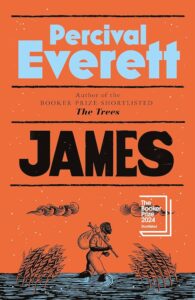 James by Percival Everett is a retelling/reimagining of the novel Adventures of Huckleberry Finn by Mark Twain from the perspective of the runaway slave Jim, known as James in his own book, who accompanies Huck Finn on his escape down the Mississippi River. I am not always a fan of retellings or spinoffs of well-known stories, but I thought the concept was rich enough and the angle intriguing enough to warrant a book like this being written. While there is plenty to like and appreciate about this book, I found it pretty disappointing and some of the choices, frankly, ludicrous.
I should note that I reread the original Adventures of Huckleberry Finn right before picking up James. Mark Twain’s original is a book that I hold in very high regard, have read multiple times, and studied pretty extensively throughout school. It’s not a perfect book by any means, but it is extremely rich in its ideas, style, presentation, and subversive and satirical nature. I don’t know if reading these two books back to back was a good or bad idea because I was judging it based off the original straight away. Part of me feels like I’m viewing it too harshly next to the titanic original when it’s clearly going for something much different, but perhaps that’s the kind of criticism you invite when you try play with established stories and characters.
Unfortunately, I found the character of James pretty uninteresting. At first, I was cautious but on board with the changes from Twain’s Jim. I get the desire to turn him into an intelligent character with more agency, but he came across like a college professor and a flat one at that. Even though the driving force is supposed to be his family, he doesn’t really think about them much with any real depth. He cares much more about his books, his pencil, and his imaginary debates with philosophers. I think this departure from Twain’s Jim is perhaps an overcompensation, as Jim is portrayed as superstitious and foolish. However unrealistic (in either novel), I could have been on board with this characterization, but he starts and ends in the same place for the most part. To me, James the character (and I guess the book by extension) came across as pompous and condescending, which is fair in a sense because he’s using the means at his disposal to overthrow the evil system of slavery, but a just cause does not make for a compelling read. The only major transformation James undergoes is into a Marvel Cinematic Universe superhero at the end, throwing out cheer-worthy lines and incredible feats of action.
In line with its comic book nature, the book goes out of its way to provide unnecessary justifications for why the original story took place. Chief among these things is the fact that, yes, Huck Finn is James’s son in this book. Woah! So, that’s why he took care of him in the original? Because he was his secret father the whole time! Of course, why didn’t I think of that? I thought its reveal and execution were so absurd that I prayed this was some sort of practical joke (or super meta satire). In another work, this concept/remix could have been explored more thoroughly and dynamically. In this, it’s thrown out into the world and then quickly dropped. While Huck’s relationship with Jim in the original is complicated, particularly in terms in what it explores about race and their respective places/classes in society, it’s simultaneously made more perplexing yet boring in this book.
In essence, this is what frustrated me the most about this book. It took the nuanced, endlessly interesting, and sometimes problematic subtext of 1884 Adventures of Huckleberry Finn and turns it into easily digestible, flat text. Maybe I just don’t really care for Everett’s writing. There were so many corny moments that had me rolling my eyes, and so many cliches in the actual writing that I thought parts of this could have been written by artificial intelligence.
Woof. Okay. It sounds like I truly hated this book, but I did not. There are some really interesting ideas and situations played with here beyond what I mentioned. The novel really shines when it takes the minstrel show angle. It interestingly explores the idea of slavery extending into using Black people’s likeness and talent as a means of control. Under the “employment” of the minstrel show, James is technically treated better and paid for his work but humiliated and degraded in their performance. Even though the owner treats James politely and as equals on the surface, it only takes a disruption in his money supply for him to sink down to level of other racist slavers. This and other sections also explore the idea of “passing” as White in interesting ways. In my opinion, these chapters also extend beyond the text itself to comment on Twain’s legacy as an anti-racist author who also enjoyed minstrel shows. Portrayals of Jim in Twain’s original could also be considered a kind of minstrel show, particularly in the disturbing conclusion of Huck Finn. Challenging Twain directly in this way was illuminating and slick. James, in his own novel, must wear layers of make-up to pass as White and then pass as a Black caricature on top of that to perform for an insane racist crowd. This multilayer critique and situation was what I felt missing from the rest of the book.
I truly wanted to love or even really like this book, but maybe I just didn’t get this book in the way the author intended. Maybe I should revisit it sometime after skipping the Huck Finn reread beforehand. Maybe.
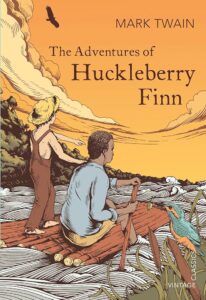 Yup, I have once again reread The Adventures of Huckleberry Finn for the fourth or fifth time. Mark Twain’s most famous novel is a biting satire of southern society, a coming of age story, a tale of empathy resisting cultural norms, and a foundational “American” novel. Huck Finn, our narrator and protagonist, is a young teenager living on fringes of White society. The sequel/spinoff to The Adventures of Tom Sawyer, the book follows Huck has he escapes his abusive father and the “sivilized” culture of slavery and hypocrisy. He joins up with Jim, a Black man escaping slavery, and they travel down the Mississippi River, getting into “adventures” (or conflicts) with various characters (feuding families, slave hunters, con men, etc.), to escape the backwards social order they’ve experienced. Just like the text itself, they must venture deeper into the racist slave society in order to escape it.
However, Huck Finn struggles with his decision to embrace or disregard the society. To Huck, the enforcement of slavery is morally right, civilized, and required by law. His resolve to be “immoral” and save Jim, damning himself to hell, is one of the most poignant moments in all of American literature. The racial elements to this book are extremely complex, and one has to really consider the time it was made and the cultural context Mark Twain lived in and the audience he wrote for. This is a book that exhibits abhorrent racism, but it is one of the greatest anti-racism books to ever be written by a White man. As a satire on southern society, it must cloak itself in its language and attitudes to break through the commonly held biases at the time. Through its language, it (tragically) grounds it in the racist reality in which the characters lived and makes Huck Finn’s transformation incredible but also incomplete.
The unfortunate truth about the ending of this book is that it sucks. After Huck decides to cast off the society that labels his friend property, he sharply regresses once my mortal enemy Tom Sawyer is reintroduced to the story. Through some absurd plot convenience, dumbass Tom Sawyer has reared his stupid little head at a random home miles and miles away from their hometown. Through more plot conveniences, the family holding Jim is that of Tom Sawyer. And Huck is confused as Tom Sawyer, so he and Tom have plenty of time to plot the most frustrating escape plan to win Jim’s freedom, which involved tremendous unnecessary suffering on the part of Jim. The book comes to a screeching halt as Tom fights Huck on every single point of the escape. It lasts FOREVER! And it makes me so damn mad that after all that growth, Huck and Jim will both follow the whims of some child who (hopefully canonically) will die in the Civil War. I can say that and not get canceled because Tom Sawyer is not real.
Despite my complaints, I have to believe that this frustrating ending is the point. Tom Sawyer, whose fantasy logic is symbolic of the cruel southern logic behind enslavement, embodies the privileged White supremacy that controls the bottom rungs of society, i.e., Huck and Jim. Once again operating under this society, they have no choice but to obey the likes of Tom Sawyer, my mortal enemy. In that sense, it might be an honest (yet disturbing) ending that still gives hope to the further growth for Huck Finn and freedom for Jim.
I know I talked a lot of the ending and plot, but the writing itself is amazing and challenging. Crazy how Mark Twain opened the floodgates for American writing to be written in a cool, chill way (i.e., not in geeky highfalutin language). This is an essential book for the story, writing, humor, and tragedy of it all. Now, I’m going to Tom Sawyer’s house to teach him a lesson, and if you drive by later and see me painting his fence, I want you to shoot me in the head.
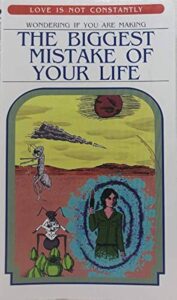 Love Is Not Constantly Wondering If You Are Making the Biggest Mistake of Your Life. That’s a fact. And this is a fact: I enjoyed this book. It was a quick interesting read in the format of a “Choose Your Own Adventure” book, aptly labeled “not a choose your own adventure” (possibly so it does not get in any sort of copyright trouble?). While on the surface, this book presents as a starfaring adventure about a pilot fighting through a planet of ant-warriors, the narrative focuses solely on a multiyear romantic relationship the protagonist has with an alcoholic.
The premise and format were immediately intriguing to me. The format and juxtaposition between the actual narrative, the alien illustrations, and the bizarre sci-fi choices to make were my favorite elements of the book. To me, these simultaneously acted as a metaphor for what happened in the central relationship and as an escape from the reality of our main character. It also brought some levity to the darker moments of this story. However, I do wish the sci-fi narrative and the reality of the relationship started to invade each other sooner and more often, even if it was more subtle. Who knows, maybe if I return to this short read, I will pick up on some more of those details!
As for the central story, a toxic and tragic love story between the narrator and Anne, I found it engaging, heartbreaking, a little Tumblr-core, and (unfortunately for me) familiar (kill me). Despite the Anne’s substance abuse and promises, the narrator keeps giving her chances, further entrenching himself into her life. It asks difficult questions, like can I change this person? Will my support be enough? Can I love them enough for their bad habit to stop? The answer to those questions is usually “no.” Living with and loving somebody who abuses substances is a difficult trek, and there are no easy answers for how navigate it or when to give up, or if ever can give up. Relating to the title, it begins to ask what are love’s limits. There are ways to beat addiction, but the main character tragically thinks he can be the sole thing to save her. This is linked to the sci-fi story with choices like, will you fight the horrific ant monster from hell or will you give up your laser blaster and surrender? Again, interesting juxtaposition.
Anne is a little bit of a manic pixie dream girl, but that’s chill. This was written in 2011 and takes place in the early 2000s, the golden age of the archetype. The main character is kind of a gigantic nerd who makes Simpsons references at inopportune times. So, yeah, I related to this book. It was a fun but unsettling ride. It ends a bit abruptly in a sightly unsatisfying way, but that’s probably the point. This book was written anonymously, but I bet it was probably that one guy who cried during Eternal Sunshine of the Spotless Mind in theaters.
 I started my year by rereading All About Love by bell hooks and finished this week, partially because I wanted to savor every idea she presents and partially because Instagram reels has fried my attention span. hooks is a one-of-a-kind thinker and writer that has written some of the most important texts on topics like gender, race, and feminism; and here she tackles the transformative power of love itself.
When I first read this book about 6 years ago (what the hell), it was like getting splashed in the face with a bucket of ice water. Its revelatory ideas about love, how it stems from childhood treatment, gets reflected throughout our lives through romantic connection, and can be and must be embraced despite the fear it traps us in whether we realize it or not, and its writing style were and are incredibly revealing to me. I felt personally called out at several points in this book, and its arguments have compelled me to approach my life and the connections I make with others more meaningful.
Coming at the book again at a much different point in my life, I still found its points, arguments, and prose incredible. It has once again grounded me in a place to appreciate and love intentionally and be more reflective about the people, places, and things in my life. It’s impossible to read this book and not insert yourself and experiences into what hooks discusses. Once again, her invitation to think about love has been challenging and therapeutic.
However, this time, I approached it with a little more maturity and found myself disagreeing and questioning her points more often. For instance, I found her points about romantically committing to somebody based on potential and vowing to change them questionable. At certain points, it’s seems like she might be contradicting herself, but I am also bringing my own personal situations and biases to the text, and it’s impossible for hooks to write a book that appeals to an entire society and also addresses me specifically (I am a freak). Some things in this book are a little dated as well, such as the Clinton sexual scandal and an overt concern with portrayals of family/romance/love in “mass media”—which at times feels like a late 90s/early 00s reductive buzzword. I wonder how she’d write this today, given the rise of things like social media (Instagram reels) and the shifting grim political landscape. hooks died in 2021 (RIP!), and I haven’t read anything of hers written after this book, so maybe she explores these concepts in the years before her passing.
To you, humble reader, it seems I may have joined a love cult. I have not, but I could. Don’t tempt me. hooks does discuss Christian religion has a major pillar of love in this book. I am not religious, and this book did not convert me, but I found people’s responses to the religious aspects quite shocking on this website for sinners. While there are certain points, especially toward the end that I found a little overbearing in religious overtones, how can you argue against prayer, which is basically just a form of self-reflection and meditation? (Just take out the God stuff. It’s literally that easy.) Religious leaders have been an important driving force in transforming our culture for the better (and worse), and discounting them for that reason is itself ignorant. Like many ancient tales, you can take the Christian bible’s stories and gain knowledge and understanding from them without being a devout believer or believer at all (like me). Take that, atheists.
Even though I just finished the book, I already want to reread it again. While I brought a much different mindset to this work, having read it before and living a little more life, I still gained plenty from this incredible book despite its cracks, which were more apparent to me this time around. This not-self-help book should be required reading for everybody, especially for the other person currently in your situationship.
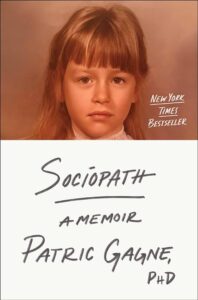 You know me. I looooove memoirs; it’s what I’m most famous for if you looked me up, which I urge you not to do. I read Sociopath by Patric Gagne, and this is one of the memoirs that I do not really like. A very interesting premise and some cool stories and internal conflicts are this book’s saving grace. The overarching narrative, struggle for self-acceptance (and societal acceptance?), and the writing (WOOF! The writing!) are all pretty weak.
Like, I get it. The premise, a self-aware sociopath who tries to forge a normal life despite her violent urges and lack of empathy, is a good one and immediately draws attention. Her youth, in particular, is interesting, as he struggles to even figure out what differentiates her from others. The broad strokes/outlines are there. However, there is nothing interesting about her writing style. The classic memoir pitfall. The only thing that memoirs need to be is true (apparently some of that is even called into question upon digging up information online?). Yet, the narrative is straightforward, corny, predictable, and, most egregiously, boring. How do you make a book about being a diagnosed sociopath boring? She focuses so much on her relationship to husband, a one-dimensional figure, and reveals where it will lead extremely early on that it removes so much tension for the rest of the book. Will they work out? Will he be able to accept her as a sociopath? Yes, doofus, obviously. I am so sorry to her husband, who is clearly a caring, smart, and influential tech guy who could give me a high-paying job some day, but anytime he was the focus it felt like I was getting hit with the brain-melting ray.
For a person who has no emotions, she sure does feel a lot toward the other characters. It’s explained away by stating that sociopathy is on a spectrum, and she landed somewhere in the middle. She flirts with deep dives on the psychology front and analyses on her condition, but nothing major is revealed. By trying to be a creative memoir and a psychological text, I think this book mostly fails at both. To be totally honest, I felt like the sociopath while reading this book. I wanted her to do more dangerous stuff and break more conventions and rules, maybe because I wasn’t getting that from the writing.
Sounds like I hated this book, but I did not. Some of her actions are so outlandish and dangerous that they were interesting to read about. And I’m glad a perspective like this exists, and I’m glad she is okay, happy, and able to tell this story. It’s just a shame that things weren’t take to the next level.
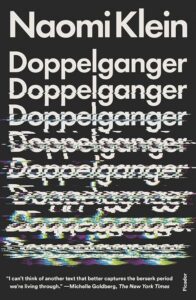 The premise of Naomi Klein’s Doppelganger, that the author shares a similar name and is confused with another woman who has taken a far-right turn, provides an interesting throughline to explore the doubling/fracturing of our politics, our world, and ourselves. Klein’s obsession with the “Other Naomi,” Naomi Wolf, and her disappearance into the “mirror world” of conspiratorial, deranged, conservative allows Klein to explore that world, its histories, and our relationship to it. Through the literary device and mythos of the doppelganger, Klein goes beyond her double to explore issues such as the anti-vaccine movement, climate change, Israel, fascism, broader conspiracies, social media, and capitalism.
While I did initially think that the premise of her being confused with a doppelganger, another Naomi, was flimsy, it became just an interesting metaphor for how “this” can turn into “that.” This book covers a lot of ground and does it quite well, balancing memoir with a deep dive into many of our social, political, and planetary problems. As the book goes on, Klein returns to the memoir elements and her personal doppelganger as a grounding and launchpoint, which might lead to some frustration for some readers who are interested purely in the one-sided relationship between these two Naomis. However, it seems like this is more personal than Klein’s previous work, which seemingly focuses on the aforementioned subject matters in greater depth.
This is a tricky book to talk about. I agree with most if not all of her arguments and points made. At a certain point in my life, when I was far more in the liberal/neoliberal camp, this book could have been life-changing. I found myself nodding my head often and vigorously, thinking, “Exactly! That’s a great way to put that.” I hope that this book can be transformative for some readers, guiding them through the arguments for a progressive, leftist future that values all life, is empathetic to people and ruthless to systems, can transform the capitalist machine grinding our brains into mush. Truthfully, this book isn’t for the faint of heart; it delves into some scary places, such as beautiful places ravaged by climate change, Nazi Germany, hateful online spaces occupied by the alt-right and their real-life outbursts of violence, and the occupation of Palestine. Each of these drawn as a doppelganger of something else. Everything from ourselves, our governments, and our planet have a doppelganger, whether its a transformation on the internet, a transformation into fanatical fascism, or a transformation into a dangerous uninhabitable ecosystem. Still, Klein urges us not to look away but address the issues head on (and, in fact, she argues that ignoring these issues is what leads to doppelgangers in the first place), destroy fascism and neoliberalism and the “self”-ishness it instills, and embrace one another as collective members of a planet on fire who can and must transform the world.
Klein also aptly describes the phenomenon in which people (fools) confuse all sequential Naomis with the first Naomi they have ever met. Similarly, every time I hear or read the name Naomi, I think of Josh from Love Island UK Season 1 shouting “NIGH-OH-MEH!” at the Naomi who he’s fallen deeply for, totally upending his previous relationship with Rachel. Perhaps that’s the true heartbreak in all of this.
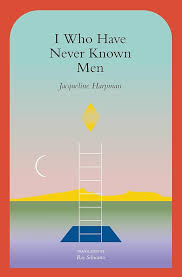 I’m not a big sci-fi guy. This is well known by all of humankind. When the people in the future look at the cave drawings I’ve made, they will deduce this about my life. My cave markings, like the book written by the narrator, will be left for whoever finds it, if anybody ever does. If they do, they will know that I am not a big sci-fi guy but loved this book.
What a devastating, insightful, and probing novel. Like many of the readers here on Goodreads—each speaking into a void—I have never read anything quite like this. From the title and the first sections, I thought I knew what this book was going for and where it was heading, but it really surprised me. Which is surprising because the narrator warns about exactly what this story is. When you strip away everything you think civilization is, what does it mean to be human? To love, be loved? To live, and to die? Yeesh, heavy, scary stuff to think about. This book put me in my place, for sure. It’s not interested in answering the reader’s questions, just as life itself does not provide easy answers. Like any sci-fi worth a damn, it uses its premise as a metaphor and a tool to guide the reader to greater truths and mysteries that we may never solve.
If and when a future civilization sees this review or my cave drawings, please know that part of my life was that I liked this book and, with the rest, I tried my best!
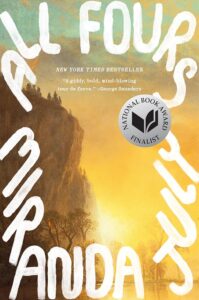 All Fours by Miranda July was a complicated and challenging book to dive into. The nameless protagonist undergoes a physical and emotional transformation over the course of the book, from a more conventional domestic lifestyle to an open, liberated lifestyle focused on personal relationships and sexual freedom. This transformation, intimate and existential, happens in tandem with (or because of) the onset of menopause. July described her book as a coming-of-age story during the other point in a woman’s life when hormonal changes can cause massive self-reflection and upheaval. In this sense, the novel crucially brings attention to this often-overlooked aspect in the lives of women. Through this lens, July thoughtfully and entertainingly prods commonly held notions of motherhood, sexuality, marriage, family, feminism, and friendships/relationships. Her prose is often easy to read, funny, insightful, and gross in an awesome way, and I flew through this book quickly because I couldn’t wait to find out what happened next!
I do have some issues with this book, though. The narrator, on her essential journey of self-discovery, is quite frantic, reckless, self-indulgent, a tad narcissist, and totally obsessive. This is a good thing. Exploring complicated subjects through complicated characters isn’t new but can continue to add richness to stories. However, the book itself doesn’t really challenge any of the protagonist’s decisions, explicitly or implicitly. Her affairs, crucial for her growth, are imbued with a sense of danger that doesn’t come to fruition. The intrusive thoughts won out. She talks about how she explodes her old life in favor of this new, more liberated one, free of motherly and domestic responsibilities, dedicated to exploring herself and others (“driving” rather than “parking”), but this explosion comes with no real cost. Harris, her husband, treats her coldly for about a week; her best friend, Jordi, supports her unconditionally; her child is just there, providing psychic guidance and plot points when necessary; and the other side characters, whose lives she should have a tremendous, possibly damaging impact on, undergo no change. In Harris’s case, the discovery of his wife’s infidelity, an important tension throughout 3/4 of the book, ends with an “Okay, let’s open up our marriage, then.” What? That’s it? Even for characters like Claire, an interesting foil whose husband-to-be has cheated on her, goes on blissfully unaware, unphased by the chaotic storm the protagonist presents (maybe because she was paid off?). In reality, the only real challenges the protagonist faces are internal.
Clearly, this book is semi-autobiographical, and I think this complicates things in a way I wasn’t quite expecting. While I am usually a big fan of this sort of writing wholesale, I thought the author’s closeness to the main character stops her from examining her choices and her impact on other people beyond just what they bring to her. The protagonist’s selfishness, which might be critiqued in a meta, nuanced, or satirical way in another book, is, to my understanding, seemingly endorsed by the author through her storytelling. Should stories be written about selfish characters with relatively easy lives who decided to make bad, irresponsible decisions that ultimately lead to a place of a happiness and more fulfilling relationships, including with oneself? Absolutely, yes. Should those systems and institutions (motherhood, marriage, etc.) be challenged in the ways presented in the book? Sure, and I like that they are. However, it’s difficult for me to reckon with her transformation when the world around her is mostly flat, on-rails, and convenient at every turn in the face of her erratic decisions. I suppose if this is how this story unfolded for the author herself, then who am I to call it unrealistic or disingenuous?
With that said, the struggle she has internally with her body is where the book shines. The crisis over the future/supposed loss of her sexuality as she knows it becomes the driving force throughout the second half of the book, especially considering that if she doesn’t figure it out, she may suffer the same fate as her aunt and grandmother. Her change into somebody more comfortable with the uncomfortable and aging itself is enlightening, breaking her familial cycle. Particularly, her conversation with other women on the subject of menopause was interesting. It’s because of this aspect that I think this is a pretty important but flawed novel. And it should be said: YES, I enjoyed the weirdo sex scenes. YES, I enjoyed when she acted like a total unhinged freak. YES, the book club I’m participating in for this book could get awkward.
I think this novel wraps up too neatly, but I overall enjoyed reading it. I struggled with the arch of the story and some of the characterizations, but the themes and prose were great. I kind of feel like there’s something I am missing out on here. This was kind of like the most annoying person you know winning the lottery. Like, I’m so happy for them, and I’m sure they’re going to spend it on something good. Oh, they’re remodeling a hotel room? Huh, that’s neat, I guess.