
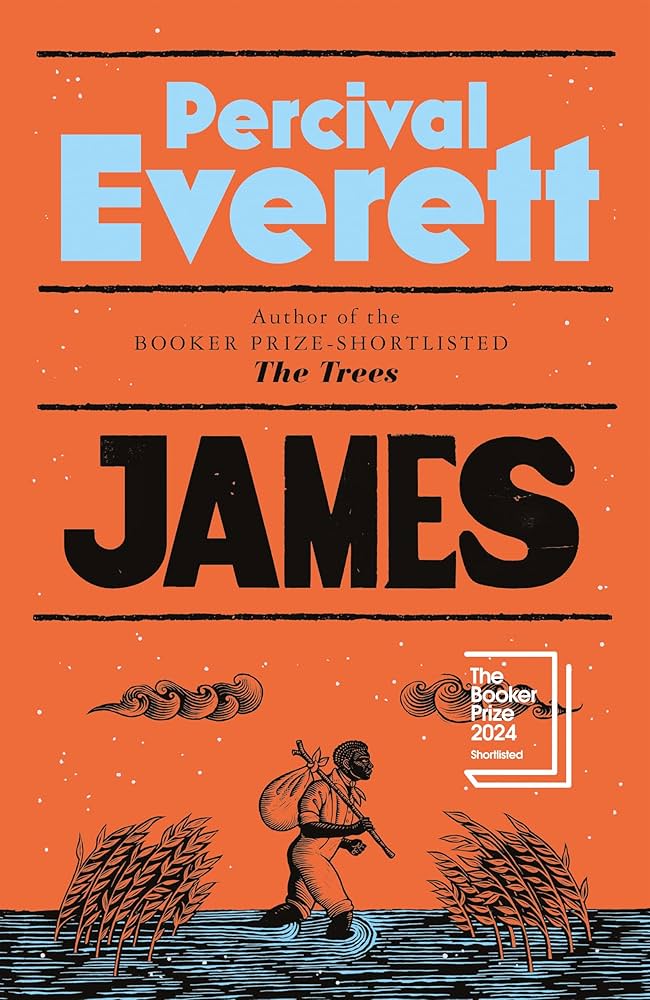
James by Percival Everett is a retelling/reimagining of the novel Adventures of Huckleberry Finn by Mark Twain from the perspective of the runaway slave Jim, known as James in his own book, who accompanies Huck Finn on his escape down the Mississippi River. I am not always a fan of retellings or spinoffs of well-known stories, but I thought the concept was rich enough and the angle intriguing enough to warrant a book like this being written. While there is plenty to like and appreciate about this book, I found it pretty disappointing and some of the choices, frankly, ludicrous.
I should note that I reread the original Adventures of Huckleberry Finn right before picking up James. Mark Twain’s original is a book that I hold in very high regard, have read multiple times, and studied pretty extensively throughout school. It’s not a perfect book by any means, but it is extremely rich in its ideas, style, presentation, and subversive and satirical nature. I don’t know if reading these two books back to back was a good or bad idea because I was judging it based off the original straight away. Part of me feels like I’m viewing it too harshly next to the titanic original when it’s clearly going for something much different, but perhaps that’s the kind of criticism you invite when you try play with established stories and characters.
Unfortunately, I found the character of James pretty uninteresting. At first, I was cautious but on board with the changes from Twain’s Jim. I get the desire to turn him into an intelligent character with more agency, but he came across like a college professor and a flat one at that. Even though the driving force is supposed to be his family, he doesn’t really think about them much with any real depth. He cares much more about his books, his pencil, and his imaginary debates with philosophers. I think this departure from Twain’s Jim is perhaps an overcompensation, as Jim is portrayed as superstitious and foolish. However unrealistic (in either novel), I could have been on board with this characterization, but he starts and ends in the same place for the most part. To me, James the character (and I guess the book by extension) came across as pompous and condescending, which is fair in a sense because he’s using the means at his disposal to overthrow the evil system of slavery, but a just cause does not make for a compelling read. The only major transformation James undergoes is into a Marvel Cinematic Universe superhero at the end, throwing out cheer-worthy lines and incredible feats of action.
In line with its comic book nature, the book goes out of its way to provide unnecessary justifications for why the original story took place. Chief among these things is the fact that, yes, Huck Finn is James’s son in this book. Woah! So, that’s why he took care of him in the original? Because he was his secret father the whole time! Of course, why didn’t I think of that? I thought its reveal and execution were so absurd that I prayed this was some sort of practical joke (or super meta satire). In another work, this concept/remix could have been explored more thoroughly and dynamically. In this, it’s thrown out into the world and then quickly dropped. While Huck’s relationship with Jim in the original is complicated, particularly in terms in what it explores about race and their respective places/classes in society, it’s simultaneously made more perplexing yet boring in this book.
In essence, this is what frustrated me the most about this book. It took the nuanced, endlessly interesting, and sometimes problematic subtext of 1884 Adventures of Huckleberry Finn and turns it into easily digestible, flat text. Maybe I just don’t really care for Everett’s writing. There were so many corny moments that had me rolling my eyes, and so many cliches in the actual writing that I thought parts of this could have been written by artificial intelligence.
Woof. Okay. It sounds like I truly hated this book, but I did not. There are some really interesting ideas and situations played with here beyond what I mentioned. The novel really shines when it takes the minstrel show angle. It interestingly explores the idea of slavery extending into using Black people’s likeness and talent as a means of control. Under the “employment” of the minstrel show, James is technically treated better and paid for his work but humiliated and degraded in their performance. Even though the owner treats James politely and as equals on the surface, it only takes a disruption in his money supply for him to sink down to level of other racist slavers. This and other sections also explore the idea of “passing” as White in interesting ways. In my opinion, these chapters also extend beyond the text itself to comment on Twain’s legacy as an anti-racist author who also enjoyed minstrel shows. Portrayals of Jim in Twain’s original could also be considered a kind of minstrel show, particularly in the disturbing conclusion of Huck Finn. Challenging Twain directly in this way was illuminating and slick. James, in his own novel, must wear layers of make-up to pass as White and then pass as a Black caricature on top of that to perform for an insane racist crowd. This multilayer critique and situation was what I felt missing from the rest of the book.
I truly wanted to love or even really like this book, but maybe I just didn’t get this book in the way the author intended. Maybe I should revisit it sometime after skipping the Huck Finn reread beforehand. Maybe.
2/5